
What the new Network Facilities Provider structure means for infrastructure providers
In brief
In April 2026 the Communications Authority of Kenya put a revised market structure in place for the telecommunications sector. It runs under the Unified Licensing Framework, is backed by a fee schedule published in June and a set of transitional provisions, and divides the sector into five broad categories of licence. The first category covers network infrastructure, and it holds the three Network Facilities Provider licences. That is where tower companies, fibre and duct owners, data centre operators and other infrastructure providers sit.
One change in that category matters most to businesses built on physical infrastructure. The Authority has drawn a firm geographic line around the lowest of the three infrastructure tiers, and it has spelled out what happens to licensees who already operate more widely. Whether it reaches a given provider depends on the tier it holds and the counties in which its infrastructure sits. This note sets out the change, why it lands squarely on the infrastructure layer of the sector, and the question it puts to licensees while the transition is still open.
The central question: Does your current authorisation still cover the infrastructure business you operate today and intend to develop going forward?
01. Where infrastructure providers sit, and how the licence sees them
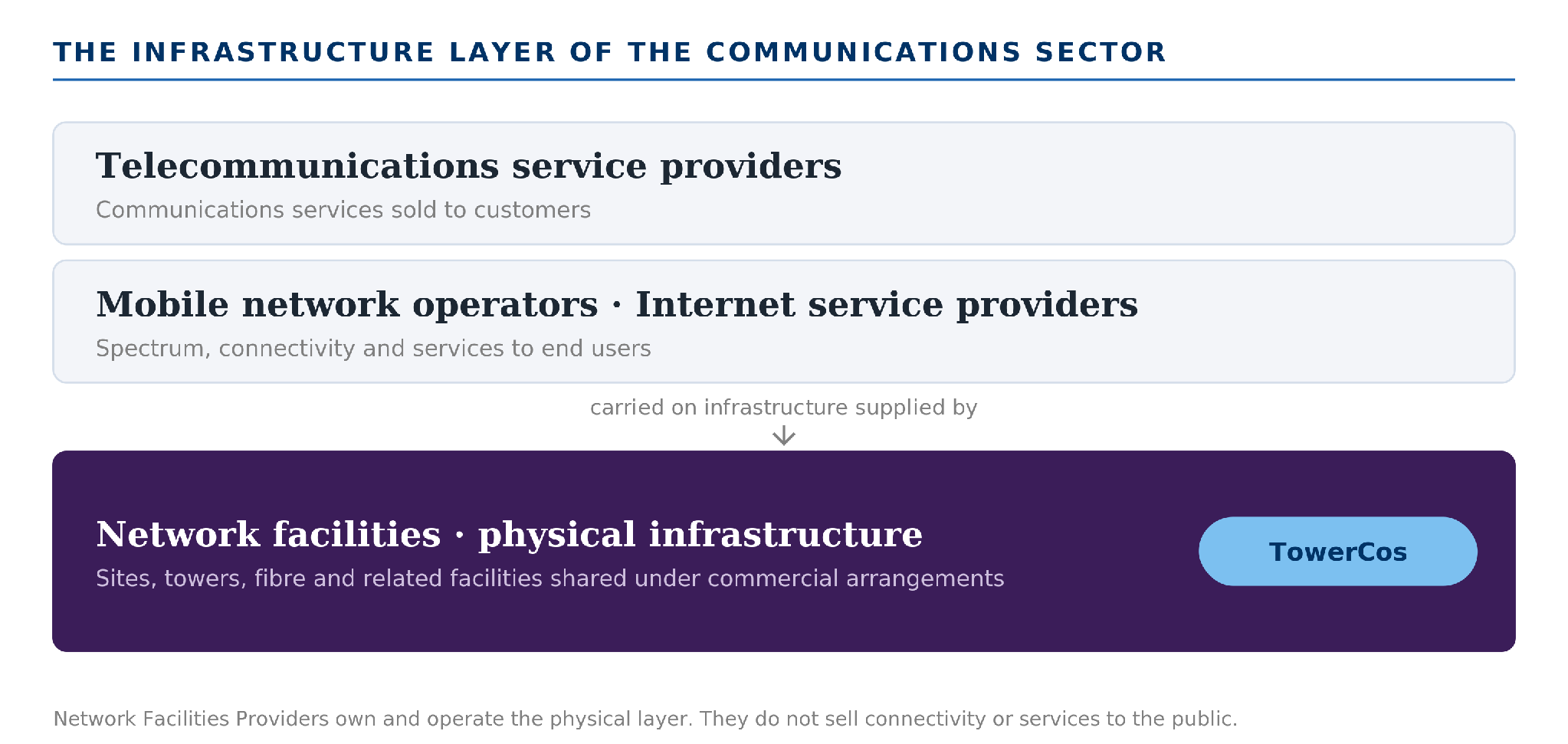
A tower company builds, owns and runs physical infrastructure. It secures and develops sites, puts up the towers, keeps them standing, and makes them available to mobile operators and other customers under commercial arrangements. Its money comes from access to that infrastructure, not from carrying traffic or selling a service to the public. Fibre and duct owners, mast providers and data centre operators sit in the same layer.
The Framework has a licence built for exactly this. A Network Facilities Provider is defined as a licensee authorised to build and commercially operate communications systems, and the infrastructure category is where that licence lives. A business of this kind is not sitting outside the regime looking in. It is the regime’s core subject.
The clearest sign of that is the co-location condition every NFP licence carries. The holder has to let other licensees share its infrastructure on terms that are reasonable, just and non-discriminatory, publish a standard co-location offer on its website, keep away from exclusive deals with building owners, and file each sharing agreement with the Authority within thirty days. For most licensees this is one compliance obligation among many. For a business whose whole model is sharing infrastructure it describes the enterprise itself, so the fit between an operator’s commercial contracts and this condition repays a close look.
None of this turns an infrastructure provider into an operator. A tower company or fibre owner is not a mobile network, an internet provider or a service provider selling to the public, and it holds none of the spectrum or service licences those businesses need. It supplies the platform they run on. That is what places it in the infrastructure category, and inside that category the licences are separated mostly by how far the holder is allowed to build.
02. Three tiers, and a new three-county line
The infrastructure category holds three licences, and geography is what mainly separates them.
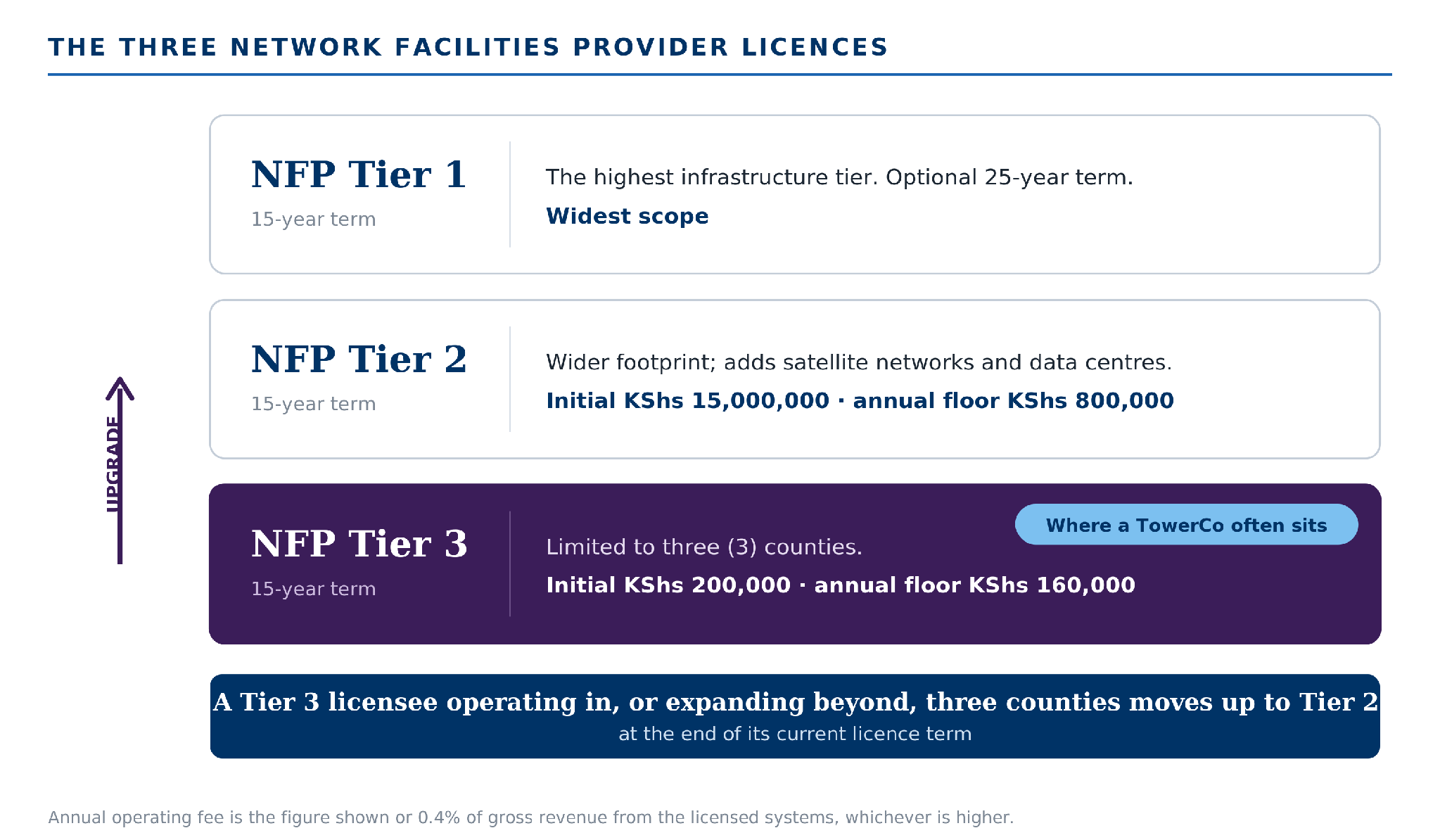
Tier 3 is the local licence. Under the revised terms it is limited to three counties, and the licence says in plain words that a Tier 3 holder wanting to operate in more than three counties has to apply for a Tier 2 licence. Tier 2 is the wider licence. It is not tied to the three-county limit, and it also covers satellite networks and commercial data centres. Tier 1 sits above both and carries an optional twenty-five year term.
The cost moves sharply between the two tiers that matter most here. A Tier 3 licence takes KShs 200,000 to pick up, with an annual operating fee of KShs 160,000 or 0.4% of gross revenue, whichever is higher. A Tier 2 licence costs KShs 15 million up front, with an annual floor of KShs 800,000 on the same basis. Both run for fifteen years. The distance between those two figures is the number to hold onto, because the transitional rules can move a licensee from the first to the second.
03. The question this puts to licensees
The transitional provisions apply the three-county cap to existing licensees, and they are precise about it. A Tier 3 licensee already operating in more than three counties has to move up to Tier 2 when its current licence ends. A Tier 3 licensee still inside three counties cannot spread past them without upgrading to Tier 2 or Tier 1. And a Tier 3 licensee that has already grown beyond three counties is held at the number of counties it runs in now until it upgrades. In every case the moment it bites is the end of the current licence term.
So for a licensee on the lower tier the answer turns on a handful of facts: the tier the current licence grants, the number of counties its infrastructure occupies today, what the growth plan assumes about new ground, and the expiry date of the present licence, which sets the timetable for the rest.
This is not a suggestion that anyone is out of line. A provider already on Tier 2 or Tier 1 is not reached by the cap, and the task there is simply to confirm the licence still matches the footprint and the plan. A Tier 3 provider that stays within three counties is fine until the plan calls for a fourth. A Tier 3 provider that has grown wider, or means to, faces the move to Tier 2 as the live issue, and the fee step and the renewal date are what a board will want in front of it. The revised structure has made the tier boundary matter in a way it may not have before.
04. Other threads worth keeping in view
Two further threads run alongside the tier question. Every NFP licence requires the Authority to be told when a shareholder’s stake crosses fifteen, thirty or fifty percent, and before anyone takes majority control, on thirty days’ notice; joint ventures above a twenty percent voting interest need sixty days. For foreign-owned groups these bite whenever the corporate structure moves, and a licence upgrade or renewal is a natural moment for the Authority to look at ownership, including the standing expectation that a foreign-owned licensee place a share of its equity with Kenyans. The exact position should be read off the particular licence and company records rather than assumed.
The second thread is the wider rulebook. The subsidiary legislation under the Kenya Information and Communications Act is still under review, and the Authority is consulting on it. Those proposals are not law yet and their final shape is unsettled. We flag them so the picture is complete, but the instruments that govern the position today are the revised market structure and the licence a business holds.
The last thread is practical. The Authority is moving its licensing work onto a new online platform, the Licensing Management System, which went live at the end of June and is being piloted with a group of licensees before a public launch planned for October 2026. Once it is running, licence applications, licence management, compliance returns and a licensee dashboard will all be handled through it. Anything a licensee decides to do, whether a Tier 2 application, a renewal or the routine annual filings, will be made through this system, so it pays to have licensing records and contact details in order before the platform becomes the main way in.
05. What licensees should do
For most infrastructure providers this calls for a short, targeted review rather than anything elaborate. A good part of it is fact-gathering that will point to a clear answer on its own.
It starts with the licence: the tier it grants, the counties named in its scope, and the date the current term ends. That end date is the transition trigger, so it drives the timing of everything else. Against the licence a provider should set its actual operations, the county count measured against the three-county line, and what the growth plan assumes. The co-location template and the sharing agreements are worth reading against the licence condition, the shareholding position against the notification thresholds, and the annual housekeeping the licence expects, including the Universal Service Fund contribution and the compliance return due by the middle of July, should be confirmed as current.
Done properly the review answers whether any step is in fact needed. If one is, it shows whether that step is a move up a tier, what it costs and when it has to happen. If nothing is needed, that position is on record. Either way the work gets done on the business’s own timetable, ahead of renewal, rather than under pressure at the counter.
06. How OLM can help
Our Telecommunications, Media and Technology team is following the revised structure, the transitional provisions and the move to online licensing as they land on infrastructure providers. If you would like us to check where your licence sits against your operations and your plans, or to sanity-check your co-location and compliance position ahead of renewal, we would be glad to help. The contacts below are a good place to start.
Key contacts
John Maina — Partner, Regulatory · TMT — [email protected]
Kenneth Likoko — Partner, Regulatory · TMT — [email protected]
Winnie Moige — Partner, Regulatory · TMT — [email protected]
This alert is a general overview of the revised telecommunications market structure and the licence terms in force in July 2026. It is provided for information only, is not legal advice, and does not create an advocate-client relationship. Any conclusion on a particular business depends on its own licence and operations, so please seek specific advice before acting.
Related insights from OLM
- Merger Notification in Kenya: When You Must File with the CAK
- Director Duties Under Kenya’s Companies Act 2015: What Boards Get Wrong
Primary sources
- Communications Authority of Kenya — revised telecommunications market structure: ca.go.ke/market-structure
- Network Facilities Provider Tier II Licence (CA template): CA Tier II licence
- Network Facilities Provider Tier III Licence (CA template): CA Tier III licence

About the author
John Maina
Partner · Advocate of the High Court of Kenya
John is a Partner at OLM Law Advocates LLP, advising corporations, banks and high-net-worth clients on corporate and commercial law, M&A, banking and finance, real estate and dispute resolution across Kenya and East Africa.
View full profile →Further reading
- Patent Registration in Kenya: How to PatentIP & Technology
- Shareholders agreements in Kenya: a practical guideCorporate Law
- Navigating the New Public Procurement Regulations in KenyaCorporate Law
- Foreign company and branch registration in KenyaCorporate Law